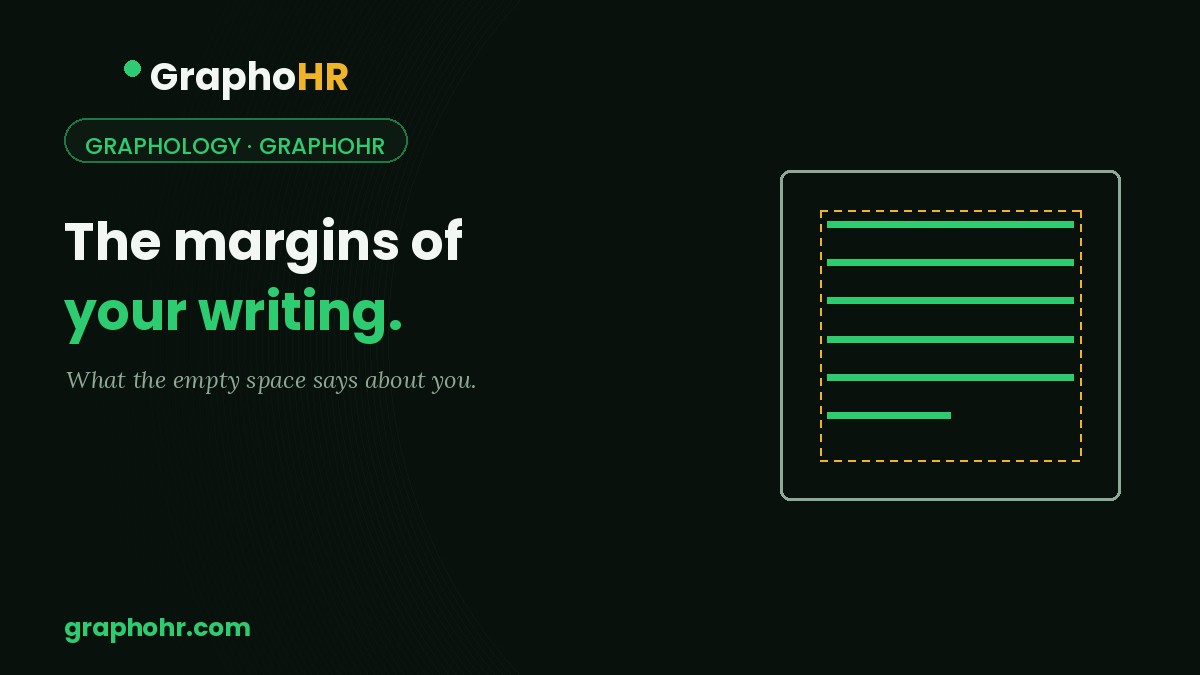
The margins of your handwriting: what the empty space says about you
When you write on a page, it's not only the letters that matter — what you leave empty matters too. Do you press the text against the edges, or surround it with wide white margins? Do you start hard against the left, or leave some air? That space we almost never notice is one of graphology's most revealing traits, because the page works as a small metaphor: it's your space, and how you manage it resembles how you manage your time, your boundaries and your relationship with the world.
Let's be clear up front: handwriting is not a crystal ball. What follows are tendencies to reflect on, not verdicts about anyone. A single trait in isolation says little; it only makes sense when cross-referenced with the rest of the writing and — above all — with a real conversation with the person.
Wide margins: air, order and perspective
Leaving generous margins around the text is usually associated with a taste for order, an aesthetic sense and a need for personal space. People who write this way tend to step back to see the whole, care about form and value their privacy. At work, that quality can translate into organization, judgment and a view that doesn't get lost in the detail.
The flip side: too wide margins can sometimes signal reserve, keeping others at a distance, or an aesthetic self-demand that's hard to let go. It's neither "good" nor "bad" — it's information about how someone builds their space.
Narrow margins: closeness, thrift and urgency
Text that fills the page to the edges, with little margin, is usually linked to sociability, a drive to make the most of things and a mind full of ideas. These are people who don't want to "waste" space, who approach without much ceremony and who are often in a hurry to express it all. On teams, that energy can bring closeness and productivity.
Its counterpart: almost non-existent margins can point to difficulty setting boundaries, some anxiety about filling the gaps, or a tendency not to give (or take) a breather. Again: context, not a label.
Left and right: where you come from and where you're going
Graphology also reads margins by side. The left margin is associated with your relationship to your origins and the past: leaving it wide often reads as a desire to move forward and let go; very narrow, as attachment to the familiar or caution. The right margin relates to the future and other people: a wide one may speak of caution about what's coming; an almost absent one, of drive and leaping without braking. These are nuances that only make sense within the whole.
What margins do NOT tell you
- They don't measure intelligence. Use of space has nothing to do with how capable someone is.
- They're not a diagnosis. They don't detect illnesses or clinical states.
- They're not permanent. They change with the type of paper, the purpose of the text, haste and even the mood of the day.
- They don't decide for you. In hiring, they should never be used as a selection criterion.
Why this matters
The point of looking at margins — and handwriting in general — isn't to "figure people out," but to open better questions. For you, it's a fun form of self-awareness: do you fill every available gap, or do you need air around what you do? For an HR team, it's a working hypothesis that helps prepare a richer interview, always validated with real evidence and with the person in the room.
That's exactly GraphoHR's philosophy: we turn handwriting and signatures into a personality and competency profile with AI, in seconds, but with the safeguards up front. Not to decide for you. To help you look — and ask — better.
Discover what your handwriting says
Grab a sheet of paper, write a few lines and upload it. 3 free analyses when you sign up.
Try it free