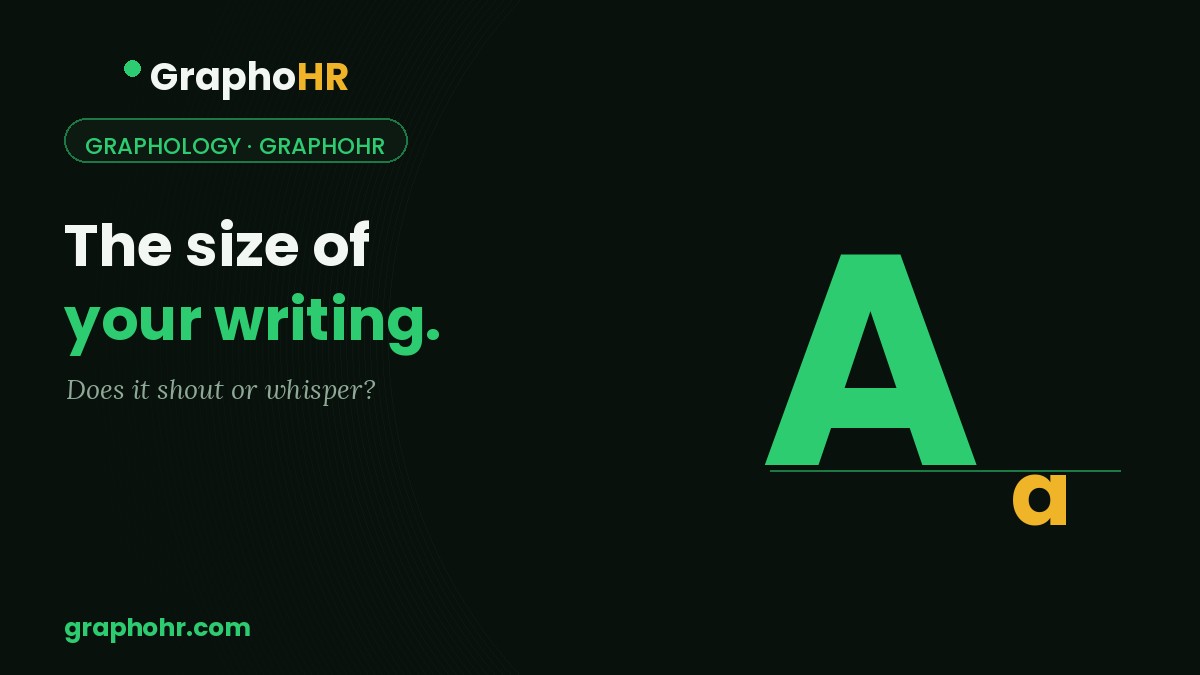
The size of your handwriting: what it says about you (and what it doesn't)
Jot down a quick note and notice something you almost never look at: how big is your handwriting? Some people fill the line with broad strokes that nearly spill off the page; others write so small you have to lean in to read it. That size is no accident. It's one of the first traits graphology looks at, because it tends to reflect how a person occupies their space — on the page and, by extension, in the world.
Let's be clear up front: handwriting is not a crystal ball. What follows are tendencies to reflect on, not verdicts about anyone. A single trait in isolation says little; it only makes sense when cross-referenced with the rest of the writing and — above all — with a real conversation with the person.
Large handwriting: presence and a need for space
Large handwriting is usually associated with extroversion, confidence and a need to express oneself. People who write big tend to take up space without asking permission: they like to be seen, to be heard, to leave a mark. At work, that quality can translate into presence, the ability to command a room, and ease with visibility.
The flip side: when handwriting is excessively large, it can sometimes signal a more intense need for attention, or difficulty adjusting to limits and detail. It's neither "good" nor "bad" — it's information about how someone seeks their place.
Small handwriting: focus and an inner world
Small, careful handwriting is often linked to concentration, analytical ability and a rich inner life. These are people who focus on detail, who observe before acting, and who frequently work better in depth than on stage. On teams, that quality can be exactly what's missing: someone meticulous, able to hold attention where others lose it.
Its counterpart: handwriting that's too small can point to shyness, a tendency to go unnoticed, or difficulty claiming one's own space. Again: context, not a label.
What size does NOT tell you
- It doesn't measure intelligence. Stroke size has nothing to do with how capable or bright someone is.
- It's not a diagnosis. It doesn't detect illnesses or clinical states.
- It's not permanent. Size changes with haste, available space, mood and even the type of paper.
- It doesn't decide for you. In hiring, it should never be used as a selection criterion.
Why this matters
The point of looking at size — and handwriting in general — isn't to "figure people out," but to open better questions. For you, it's a fun form of self-awareness: does your handwriting fill the page with confidence, or tuck itself discreetly into a corner? For an HR team, it's a working hypothesis that helps prepare a richer interview, always validated with real evidence and with the person in the room.
That's exactly GraphoHR's philosophy: we turn handwriting and signatures into a personality and competency profile with AI, in seconds, but with the safeguards up front. Not to decide for you. To help you look — and ask — better.
Discover what your handwriting says
Grab a sheet of paper, write a few lines and upload it. 3 free analyses when you sign up.
Try it free