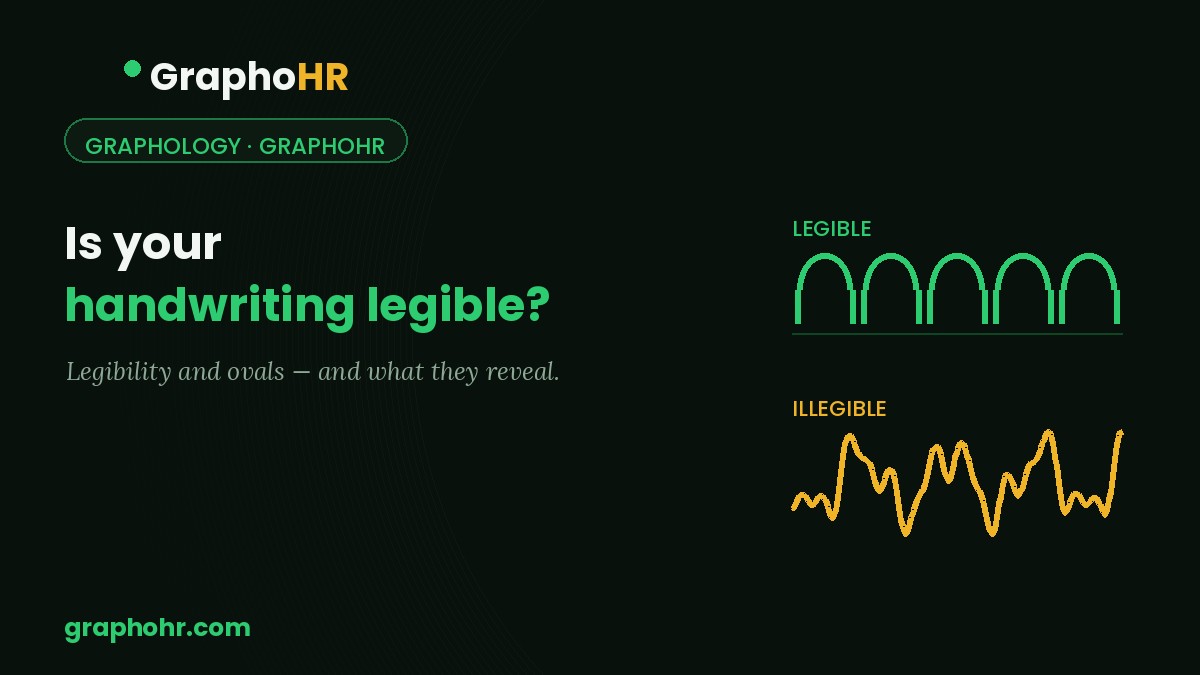
Is your handwriting legible? What clarity and your ovals say about you
Some handwriting anyone can read at a glance; some even its own author can't decipher the next day. Between those two extremes lies one of the most social traits of writing: legibility. Closely tied to it are the ovals — the round letters like a, o and d — which graphology reads as the "door" to your communication. Together they speak to something very concrete: how much you do (or don't) want others to understand you.
Let's be clear up front: handwriting is not a crystal ball. What follows are tendencies to reflect on, not verdicts about anyone. A single trait in isolation says little; it only makes sense when cross-referenced with the rest of the writing and — above all — with a real conversation with the person.
Legibility: do you want to be understood?
Clear, legible writing is often associated with transparency, mental order and consideration for the reader: there's care taken to be understood. People who write legibly tend to want to communicate without misunderstandings, to put things on the table. In a work setting, it's linked to clarity in laying out ideas and making it easy for others to follow their thinking.
Closed or hard-to-read writing isn't automatically the opposite. Sometimes it speaks of reserve or an inner world not shared with just anyone; other times, simply, of a mind moving faster than the hand (there's a reason people joke about doctors' handwriting). The nuance matters: illegible from speed isn't the same as illegible from wanting to hide.
The ovals: the door to your communication
Now look at your ovals — the round part of a, o, d, g. An open oval at the top is usually tied to expressiveness, frankness and a wish to communicate: people who say what they think. A closed, tight oval tends to speak of discretion and prudence, someone who holds things back. And when the oval carries inner loops, it's often read as reserve: there's a part being protected.
The flip side: too much openness can be a lack of filter, and too much closure, difficulty opening up. It's neither "good" nor "bad" — it's information about how someone manages what they show and what they keep.
What legibility does NOT tell you
- It doesn't measure intelligence. Having messy or illegible handwriting says nothing about how capable someone is.
- It's not a diagnosis. It doesn't detect illnesses or clinical states.
- It's not permanent. It changes with haste, tiredness, the type of task and even the pen.
- It doesn't decide for you. In hiring, it should never be used as a selection criterion.
Why this matters
The point of looking at legibility and ovals — and at handwriting in general — isn't to "figure people out," but to open better questions. For you, it's a fun form of self-awareness: do you work to be understood, or write just for yourself? If you want to look at your whole writing, here's a quick guide to analyzing your handwriting trait by trait. For an HR team, it's a working hypothesis that helps prepare a richer interview, always validated with real evidence and with the person in the room.
That's exactly GraphoHR's philosophy: we turn handwriting and signatures into a personality and competency profile with AI, in seconds, but with the safeguards up front. Not to decide for you. To help you look — and ask — better.
Discover what your handwriting says
Write a few lines and upload them. 3 free analyses when you sign up.
Try it free