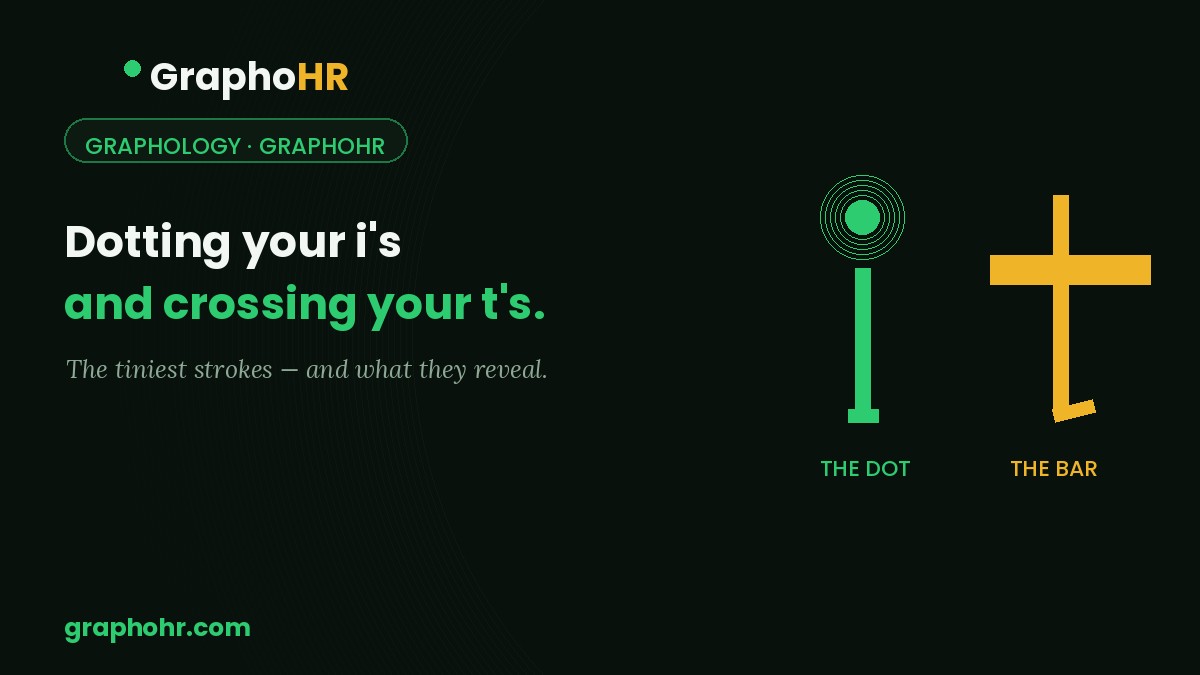
Dotting your i's and crossing your t's: what those tiny strokes reveal
They're the smallest gestures in all of your writing: the little dot you drop over the i and the short stroke you cross the t with. Almost no one thinks about them while writing — they just happen — and that's exactly why graphology pays them so much attention. They're finishing touches: the way you complete a detail when you think no one is watching. It's no accident the English idiom for being meticulous is precisely "dotting your i's and crossing your t's."
Let's be clear up front: handwriting is not a crystal ball. What follows are tendencies to reflect on, not verdicts about anyone. A single trait in isolation says little; it only makes sense when cross-referenced with the rest of the writing and — above all — with a real conversation with the person.
The dot on the i: precision and attention to detail
Notice where your dot lands. A precise dot, right above the i is often linked to attention to detail, memory and care: people who finish what they start. A dot shifted to the right tends to speak of impatience, or a mind moving faster than the hand. High above the letter is tied to imagination and curiosity; turned into a circle, to originality and a wish to stand out. And when the dot is missing, it usually points to haste — seeing the forest rather than the tree.
The flip side: too much precision can turn into perfectionism or difficulty letting go. It's neither "good" nor "bad" — it's information about how someone tends to detail.
The bar on the t: willpower and energy
Now look at how you cross your t. A long, firm bar usually reflects willpower, drive and determination: energy to carry things through to the end. A short or weak bar tends to speak of less push in the moment, or holding energy in reserve. High, near the top, is associated with ambition and demanding goals; low, with a more grounded, practical focus. And a bar that slants sharply down is often linked to stubbornness or firmness in standing your ground.
The counterpart: an overly dominant bar can speak of control or a need to impose. Again: context, not label.
What these details do NOT tell you
- They don't measure intelligence. Finishing the i or not says nothing about how capable someone is.
- They're not a diagnosis. They don't detect illnesses or clinical states.
- They're not permanent. They change with haste, tiredness, the type of task and even the pen.
- They don't decide for you. In hiring, they should never be used as a selection criterion.
Why this matters
The point of looking at these finishing touches — and at handwriting in general — isn't to "figure people out," but to open better questions. For you, it's a fun form of self-awareness: do you tend to the details, or go straight to the point? For an HR team, it's a working hypothesis that helps prepare a richer interview, always validated with real evidence and with the person in the room.
That's exactly GraphoHR's philosophy: we turn handwriting and signatures into a personality and competency profile with AI, in seconds, but with the safeguards up front. Not to decide for you. To help you look — and ask — better.
Discover what your handwriting says
Grab a sheet, write a few lines and upload them. 3 free analyses when you sign up.
Try it free